by Tracy Hookstra | August 18, 2026
DALLAS-FORT WORTH REAL ESTATE
A beautifully renovated home can make an unforgettable first impression.
But when it comes to understanding Dallas home value, new finishes are only one part of a much larger equation.
For homeowners considering a renovation or preparing to sell, understanding Dallas home value can raise an important question: Which improvements will add the most value to my home? A new kitchen? An updated primary bath? New flooring, windows or an expanded living space?
The answer is not always as straightforward as the renovation itself. In the Dallas-Fort Worth real estate market, a home’s value is influenced by the relationship between its condition, improvements, location, surrounding properties and current buyer demand. A beautifully remodeled home may attract more buyers and command a higher price, but the market ultimately determines how much value those improvements contribute.
This becomes particularly important throughout Dallas-Fort Worth, where buyers can choose among established neighborhoods filled with older homes, extensively renovated properties, luxury new construction and rapidly growing master-planned communities. Understanding what creates value within each of those markets can help homeowners make smarter decisions before investing in major improvements.
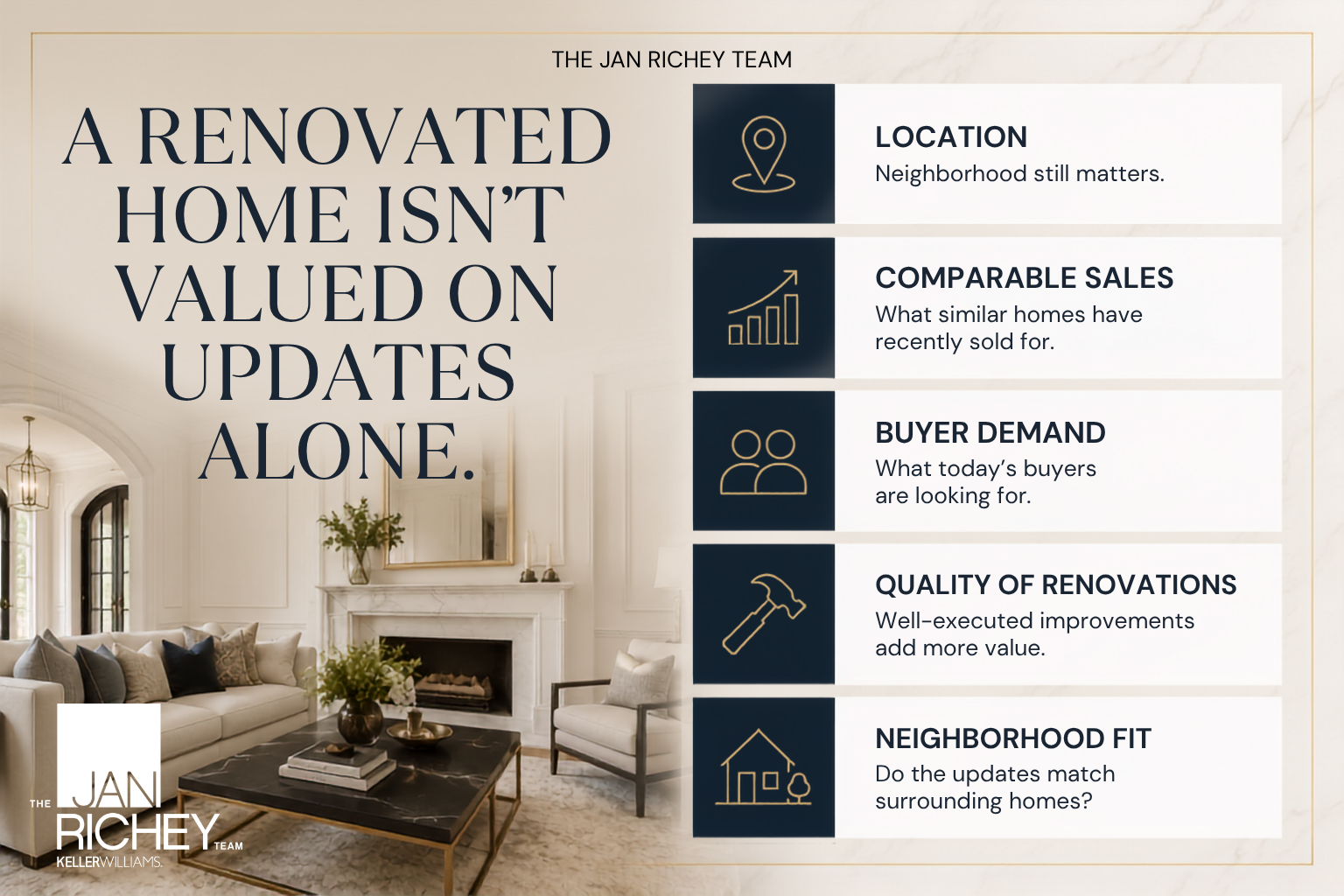
There is a reason “location, location, location” has remained one of real estate’s most familiar principles. A home can be renovated repeatedly throughout its lifetime, but its physical location remains the one thing an owner cannot change.
Location also means much more than a city, neighborhood name or ZIP code. Buyers consider the character of the surrounding neighborhood, nearby schools and amenities, access to employment centers, shopping and dining, commute patterns, parks and trails, lot characteristics and future development. Even the home’s position within a neighborhood can influence buyer perception and, ultimately, market value.
This is especially apparent when evaluating Dallas home value, where buyer expectations can change significantly from one neighborhood to another. An older home in an established, highly desirable area may command considerable value even before extensive renovations because buyers are purchasing more than the structure itself. They are also purchasing the location, lot, neighborhood and lifestyle that come with it.
The opposite can also be true. A beautifully renovated property in an area with lower buyer demand may not achieve the same value as a similarly updated home in a location where buyers are actively competing for properties. This is why evaluating a renovation without considering the surrounding real estate market can create unrealistic expectations about its potential return.
There is no single characteristic that defines a “good” location. Instead, value tends to reflect the features buyers within a particular market prioritize.
For some Dallas-Fort Worth buyers, proximity to major employment centers or convenient access to highways may be particularly important. Others may prioritize highly regarded schools, nearby restaurants and shopping, larger homesites, mature trees, neighborhood amenities or proximity to recreation and entertainment.
Those preferences can also evolve over time. New development, infrastructure improvements and changing lifestyle trends can strengthen demand in one area while buyer preferences shift elsewhere. This is one reason understanding local market conditions and comparable home sales is so important when evaluating a property’s current value.
“A home can be transformed through renovation. Its location, however, remains part of the property forever.”
Renovations absolutely have the potential to increase a home’s desirability and market value. However, one of the most important distinctions for homeowners to understand is that the amount spent on an improvement does not automatically equal the amount of value added to the property.
Appraisers and real estate professionals look at how buyers respond to improvements within that specific market. A $100,000 renovation does not automatically increase a home’s market value by $100,000 simply because that was the cost of completing the work.
Instead, the type of improvement, quality of construction, functionality and consistency with surrounding properties all matter. Modern kitchens and bathrooms, updated flooring and finishes, energy-efficient improvements, functional floor plan changes and well-executed additions may contribute positively to value when those features align with what buyers expect and are willing to pay for in that neighborhood.
Quality matters as well. Thoughtful renovations that complement a home’s architecture and feel cohesive throughout the property can create a very different buyer response than improvements made solely to follow a current trend. In the luxury market especially, buyers often notice craftsmanship, material quality, scale and attention to detail.
Yes, and this is where understanding the neighborhood becomes particularly important.
A homeowner may choose exceptionally high-end finishes, extensive custom features or a major addition because those improvements enhance their own enjoyment of the property. There is nothing wrong with renovating for personal lifestyle, but those choices should not automatically be viewed as investments that will produce an equivalent financial return.
If surrounding homes are selling within a relatively consistent range, there may eventually be a ceiling on what buyers are willing to pay, regardless of how much has been invested in one particular property. An improvement that supports Dallas home value in one neighborhood may be considered excessive in another market.
For homeowners planning to sell within the next few years, this distinction can be especially important. The goal is not necessarily to make a home the most extensively renovated property in the neighborhood. Often, the smarter strategy is to understand which improvements buyers in that specific market actually value.
Today’s buyers are not simply searching for something that looks new. Increasingly, they are looking for homes that combine aesthetics with functionality, quality and a sense of place.
Move-in-ready and remodeled homes continue to appeal to buyers who would prefer to avoid taking on major projects after closing. Updated kitchens and bathrooms remain important, but buyers are also paying attention to how a home functions from day to day. Flexible living spaces, thoughtful storage, natural light, energy efficiency, indoor-outdoor connections and comfortable spaces for entertaining can all influence the way a property is perceived.
In the Dallas-Fort Worth luxury real estate market, buyers may be particularly discerning about the quality of those improvements. High-end finishes alone do not necessarily create a luxury experience. Proportion, architecture, craftsmanship and the relationship between rooms can be just as important as the individual materials selected.
This is also where older homes can have a distinct advantage. Established properties may offer mature landscaping, larger lots, architectural details or locations that cannot easily be recreated with new construction. When those characteristics are paired with thoughtful modernization, the result can be especially compelling to buyers.
Some of the most successful renovations do not attempt to turn a property into something it was never intended to be. Instead, they improve functionality while respecting the character, scale and architecture of the original home.
That may mean opening portions of a floor plan without eliminating every defined space, updating a kitchen while maintaining architectural consistency or adding modern conveniences without removing the features that make an older property distinctive.
For homeowners, the question should not only be, “What is popular right now?” It should also be, “What improvements make sense for this particular home, in this particular neighborhood, for the buyers most likely to purchase it?”
That is where renovation strategy and real estate strategy begin to overlap.
An appraisal is not based on personal preference, and an appraiser does not simply add the cost of each renovation to the previous value of the home. Instead, the appraisal process relies on market evidence and the behavior of buyers and sellers.
When evaluating Dallas home value, appraisers consider a property’s location, size, condition, features and improvements in relation to comparable properties that have recently sold. They analyze whether similar renovated homes have commanded higher prices, how much buyers appear willing to pay for certain features and whether the property’s improvements are consistent with its surrounding market.
This is an important distinction for homeowners because the question is not simply, “How much did I spend?”
THE APPRAISAL PERSPECTIVE
A more meaningful question is:
“How does the market respond to these improvements within this specific location?”
That perspective, shared by Gardiner Ray Appraisals, shifts the conversation away from renovation cost and toward actual buyer behavior. If comparable renovated homes are consistently selling at a premium, there may be clear market evidence supporting additional value. If the market shows little difference between heavily renovated properties and more moderately updated homes, the potential return may look very different.
Before committing to a major renovation with the expectation of increasing your home’s sale price, it is worth understanding what buyers are already rewarding in your neighborhood.
Recent comparable sales can reveal much more than a general online estimate. Look at which homes are selling successfully, how their condition compares with yours and which improvements appear consistently among properties commanding stronger prices. It is equally important to consider how much separation exists between renovated and unrenovated homes in the same immediate market.
Sometimes the data may support a substantial renovation. In other situations, a more strategic approach, such as updated paint, lighting, flooring, landscaping or targeted repairs, may make more financial sense before listing.
For a luxury home in Dallas-Fort Worth, this analysis becomes even more valuable because renovation costs can escalate quickly. Understanding the potential market response before making a significant investment can help homeowners decide whether an improvement is likely to enhance resale value, primarily enhance their own lifestyle or accomplish both.
Preparing a property for market involves more than choosing what to remodel. Timing, pricing, presentation, competition and current inventory all influence the outcome.
A beautifully renovated home can still struggle if it enters the market at a price buyers do not perceive as supported by comparable sales. Conversely, a well-positioned home with selective updates and strong presentation may outperform expectations when it meets an unmet need in its neighborhood.
This is why homeowners considering a future sale can benefit from discussing their plans with a knowledgeable real estate professional before beginning an expensive renovation. Understanding the local market first can help determine where improvements are most likely to make an impact.
If you are considering renovations, preparing to sell or simply want a clearer understanding of your home’s position in the market, meet The Jan Richey Team and connect with one of our experienced North Texas real estate professionals for local guidance tailored to your property and goals.
There is no universal formula that says location accounts for one percentage of value and renovations account for another. Real estate is far more nuanced than that.
Location provides the foundation. The home itself, its condition and its improvements build upon that foundation. Buyer demand, comparable sales and current market conditions ultimately determine how those characteristics translate into market value.
The strongest properties often bring those elements together: a desirable location, improvements appropriate for the surrounding market, quality execution and features today’s buyers actually value.
For homeowners considering renovations, preparing to sell or simply researching Dallas home value, understanding the difference between renovation cost and market value is an important place to begin. Before making a major investment, look beyond the finishes and consider the larger picture: the home, the neighborhood, the buyer and the market in which they all come together.
THE BOTTOM LINE
A renovation can transform the way a home looks and lives.
The market ultimately determines what that transformation is worth.
The Jan Richey Team would like to thank David Ray and Gardiner Ray Appraisals for sharing their professional appraisal perspective and insight into the relationship between location, renovations and residential property value.

© 2026 The Jan Richey Team. All Rights Reserved. | Client Login